 English
 中文简体
中文简体
Cryogenic vials with codes are essential components in modern laboratories, biotechnology research centers, pharmaceutical development facilities, and biobanks. These precision-engineered containers are designed to safely store valuable biological samples such as cells, tissues, proteins, and nucleic acids at ultra-low temperatures. Maintaining leakproof integrity over extended storage periods is critical to ensuring that samples remain uncontaminated and traceable, especially when stored in liquid nitrogen or deep-freeze conditions.
Understanding cryogenic vials with codes
Cryogenic vials with codes are specialized sample storage tubes engineered for ultra-low temperature applications, often reaching –196°C in vapor phase liquid nitrogen. What sets these vials apart is the integrated coding system — typically 2D barcodes, alphanumeric identifiers, or laser-etched markings — that allows users to easily track, retrieve, and verify samples in automated or manual storage systems.
These codes are usually positioned on the vial base or cap and are designed to remain readable under extreme conditions. They integrate seamlessly with laboratory information management systems (LIMS), making them a preferred choice for facilities handling large-scale biorepositories.
Key purposes of cryogenic vials with codes
- To provide secure, traceable identification for each biological sample.
- To maintain sterility and leakproof integrity under cryogenic conditions.
- To enable automation compatibility, allowing barcode scanners or robotic arms to process samples efficiently.
- To ensure long-term preservation without contamination, evaporation, or label degradation.
Material selection and its impact on leakproof performance
The foundation of leakproof reliability begins with the material composition of cryogenic vials with codes. These vials are typically made from high-grade polypropylene, which remains stable, flexible, and non-reactive at ultra-low temperatures. The material must withstand both freezing and thawing without cracking or losing elasticity.
Characteristics of optimal materials
| Material Property | Importance for Leakproof Performance |
|---|---|
| Thermal stability | Prevents brittleness and cracking at low temperatures |
| Chemical resistance | Ensures compatibility with stored biological samples |
| Low permeability | Reduces vapor exchange and potential leakage |
| Durability | Maintains vial integrity under mechanical stress |
| Sterilization tolerance | Allows for gamma irradiation or autoclaving without deforming |
Choosing vials manufactured from medical-grade, virgin polypropylene minimizes the risk of microfractures, which can compromise the seal and lead to sample loss. Users should verify that the vials are certified for cryogenic storage in vapor-phase liquid nitrogen and have been tested for pressure resistance.
Design features that ensure leakproof integrity
The design of cryogenic vials with codes plays a crucial role in maintaining a secure, leakproof seal during freezing, storage, and thawing. Each design element — from the cap thread to the gasket and tube geometry — influences the overall performance.
Threading and sealing mechanisms
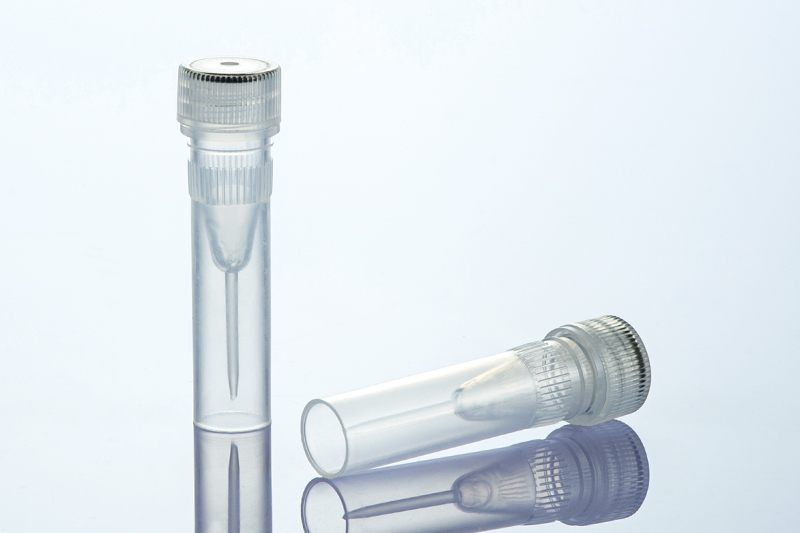
Cryogenic vials generally come in two types: internal-thread and external-thread designs.
- Internal-thread vials: The cap screws inside the vial neck, minimizing external contamination risk. These often include an internal silicone O-ring or gasket that provides a secondary seal, enhancing leakproof performance.
- External-thread vials: The cap threads externally onto the vial, which simplifies handling but may expose threads to frost buildup. They often rely on precise thread design to maintain sealing tightness.
Both configurations can achieve excellent performance when properly manufactured. However, users should ensure that the thread design prevents cross-threading, as misalignment can compromise the seal.
Cap and gasket design
High-quality caps and sealing gaskets are central to preventing leaks. Silicone or thermoplastic elastomer gaskets are commonly used due to their elasticity and ability to maintain tight compression even after multiple freeze-thaw cycles. A precision-engineered cap fit ensures even pressure distribution across the vial opening.
Bottom and sidewall geometry
The thickness and uniformity of the vial wall prevent deformation during temperature changes. A thicker bottom helps the vial resist pressure differentials, particularly in vapor-phase storage. Smooth interior surfaces minimize sample adherence and allow consistent sealing between vial and cap.
The importance of proper coding durability
The coding system on cryogenic vials with codes serves both identification and traceability purposes. However, the code’s durability under cryogenic conditions is essential for maintaining reliable records throughout the sample’s storage lifecycle.
Types of coding technologies
- Laser-etched 2D barcodes: Resistant to solvents and temperature changes; cannot peel or fade.
- Printed or ink-based codes: Must be chemical- and frost-resistant; risk of smudging or detachment if improperly handled.
- Embedded digital codes: Permanently integrated into the plastic material for maximum durability.
A robust coding system not only reduces sample mix-ups but also ensures data integrity for regulatory compliance. When selecting cryogenic vials with codes, verify that the coding technology has been validated for cryogenic readability and optical scanner compatibility.
Handling and storage practices to prevent leakage
Even with the best materials and designs, improper handling or storage practices can lead to seal failure or leakage. Users must follow controlled procedures during sample filling, capping, freezing, and long-term storage.
Proper filling technique
Avoid overfilling cryogenic vials with codes. Leave sufficient headspace (approximately 10%) to accommodate sample expansion during freezing. Overfilled vials can cause the cap to loosen or the vial to rupture under pressure.
Cap tightening and inspection
Before placing vials in storage:
- Ensure caps are evenly tightened without over-torquing, which may deform the threads.
- Inspect gaskets and threads for any signs of damage or contamination.
- If vials are reused (for non-sterile applications), confirm that all seals remain intact.
Storage positioning
Store vials upright whenever possible, as this reduces pressure on the seal and prevents potential leakage through the threads. Use cryogenic vial racks that support consistent orientation and prevent vibration.
Avoid direct immersion in liquid nitrogen
Cryogenic vials with codes should ideally be stored in the vapor phase above liquid nitrogen rather than fully immersed. Direct immersion may cause liquid nitrogen to enter the vial if the seal is imperfect, leading to internal pressure buildup during thawing.
Ensuring sterility and contamination control
Leakproof performance is closely tied to sterility assurance. Contaminants or residue on the vial surface or threads can interfere with the seal, increasing the risk of leakage or cross-contamination.
Sterilization methods
Manufacturers typically sterilize cryogenic vials with gamma irradiation or ethylene oxide (EtO) treatment. Users should verify that the sterilization method does not compromise material integrity. Avoid autoclaving vials that are not specifically rated for high-temperature sterilization, as deformation may occur.
Handling precautions
- Always handle vials with clean gloves or tools to avoid introducing particles or residues.
- Maintain a controlled environment when opening or sealing vials to prevent airborne contamination.
- Use filtered pipette tips to minimize liquid transfer contamination.
Performance testing and quality assurance
To ensure cryogenic vials with codes remain leakproof during long-term storage, quality testing and validation are essential both at the manufacturing stage and within the laboratory.
Common performance validation tests
| Test Type | Purpose | Expected Outcome |
|---|---|---|
| Leakproof test under pressure | Simulates nitrogen vapor pressure | No leakage detected |
| Thermal cycling test | Assesses durability across freeze-thaw cycles | Maintains seal integrity |
| Barcode readability test | Ensures code readability after exposure to low temperatures | Codes remain scannable |
| Chemical compatibility test | Checks for interaction with stored substances | No degradation or reaction |
Laboratories should periodically conduct in-house verification by testing random vial samples, especially after long-term storage, to confirm ongoing integrity.
Integration with automation and traceability systems
In modern laboratories, automation plays an increasingly vital role in managing cryogenic storage. Cryogenic vials with codes are designed to integrate seamlessly with automated liquid handling systems, robotic sample retrieval, and barcode scanners.
Automation not only improves operational efficiency but also minimizes human handling, which reduces the risk of seal damage and contamination. The compatibility of vials with scanning systems, including 2D barcode readers, ensures that each sample remains traceable even in frozen conditions.
To maintain system compatibility:
- Ensure that the vial’s code format matches your LIMS database structure.
- Verify that frost or condensation does not interfere with scanning accuracy.
- Conduct regular calibration of barcode scanners to ensure consistent readability.
Shelf life and long-term storage considerations
Long-term sample preservation demands careful control of both environmental and mechanical factors. Over years of storage, even minor temperature fluctuations or improper sealing can compromise sample quality.
Factors influencing long-term reliability
- Temperature consistency: Maintain steady cryogenic temperatures without frequent thawing.
- Vibration and movement: Reduce handling and mechanical stress that could loosen caps.
- Material aging: Replace vials that show discoloration, warping, or cracking after extended use.
- Data tracking: Implement a robust tracking system to record the storage duration and conditions for each sample.
Regularly inspecting and replacing aging cryogenic vials with codes is a preventive measure that ensures leakproof performance throughout extended storage durations.
Troubleshooting common leak-related issues
When leakage or frost buildup occurs, identifying the cause is essential to prevent recurrence. Below are common issues and their likely causes.
| Issue | Possible Cause | Recommended Solution |
|---|---|---|
| Cap loosening during freezing | Overfilled vial or thermal expansion | Reduce sample volume, ensure proper headspace |
| Frost accumulation around cap | Exposure to humid air | Handle vials in low-humidity environment |
| Code unreadable after freezing | Frost or code degradation | Use laser-etched 2D barcodes; wipe surface gently before scanning |
| Leak detected after thawing | Cap deformation or damaged gasket | Replace vial; inspect gaskets before reuse |
Addressing these issues promptly ensures ongoing reliability and minimizes sample loss.
Best practices summary for leakproof storage
Maintaining leakproof performance in cryogenic vials with codes requires consistent adherence to best practices across the entire sample management process.
| Category | Best Practice | Benefit |
|---|---|---|
| Material selection | Use virgin polypropylene rated for cryogenic storage | Prevents cracking or brittleness |
| Sealing design | Select vials with high-quality gaskets and thread precision | Ensures tight, uniform sealing |
| Handling procedure | Avoid overfilling and cross-threading | Prevents pressure-induced leakage |
| Storage method | Store upright in vapor phase, not immersed | Reduces risk of nitrogen infiltration |
| Traceability system | Choose durable laser-etched coding | Maintains data accuracy throughout storage |
| Inspection and maintenance | Perform regular leak and integrity checks | Detects early signs of seal failure |
By integrating these best practices into laboratory protocols, users can achieve reliable long-term preservation and eliminate costly sample losses.
Conclusion
Ensuring that cryogenic vials with codes remain leakproof during long-term cryogenic storage is a multifaceted process that involves attention to material selection, design precision, handling discipline, and storage conditions. Reliable cryogenic storage is not solely dependent on the vial itself; it also relies on consistent operational standards and regular integrity checks.
By selecting vials made from durable, cryogenic-rated materials with precision-engineered sealing systems and permanent coding, laboratories can maintain both sample integrity and traceability. Combined with proper handling, sterilization, and quality assurance practices, cryogenic vials with codes will provide secure, contamination-free, and leakproof sample preservation — safeguarding valuable biological materials for years to come.